
Crosses
Unknown Artist
3rd–12th century
Medium
Mother of pearl, bronze
Dimensions
A: H. 1 9/16 in. (4 cm) W. 1 1/16 in. (2.7 cm) D. 1/8 in. (0.3 cm) Wt. 0.23 oz. (6.5 g) B: H. 1 3/8 in. (3.5 cm) W. 7/8 in. (2.2 cm) D. 1/8 in. (0.3 cm) Wt. 0.17 oz. (4.8 g)
Classification
Jewelry
Department
Islamic Art
Museum
Metropolitan Museum of Art, New York, NY
Credit
Gift of Helen Miller Gould, 1910
Accession Number
10.130.1162a, b
Rights
Public Domain
Art Historical Context
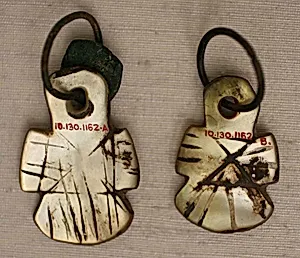
These delicate crosses, crafted from mother-of-pearl and bronze between the 3rd and 12th centuries, exquisite miniature jewelry from the early medieval world. Measuring just over an inch in height, the two pieces (A: 1 9/16 in. high; B: 1 3/8 in. high) are remarkably lightweight—under a quarter ounce each—suggesting they served as pendants or amulets worn close to the body. Housed in the Metropolitan Museum of Art's Islamic Department, they highlight the cultural intersections in regions like the Middle East and North Africa, where Christian communities thrived amid diverse influences. Mother-of-pearl, prized for its luminous iridescence, was a favored material in both Christian and Islamic craftsmanship, often carved or inlaid with bronze for contrast and durability. These crosses reflect artisanal techniques of the era, where shell was meticulously shaped into symbolic forms, symbolizing faith and protection. Their presence in an Islamic art collection underscores the shared artistic heritage across religious boundaries, as early Islamic empires preserved and traded such artifacts from Byzantine, Coptic, or Syriac traditions. A generous gift from Helen Miller Gould in 1910, these crosses invite visitors to ponder the portable piety of ancient wearers, bridging epochs and faiths in a single, shimmering glance.