
Crucifix
c. 1700/35
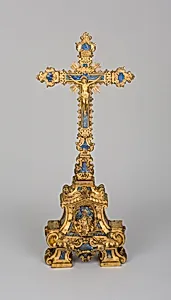
Medium
Gilt bronze, lapis lazuli
Dimensions
105.4 × 43.5 cm (41 1/2 × 17 1/8 in.)
Classification
bronze
Department
Applied Arts of Europe
Museum
Art Institute of Chicago
Accession Number
24827
Rights
Public Domain
Art Historical Context
This exquisite *Crucifix*, crafted around 1700–1735, stands as a masterful example of European applied arts from the early 18th century.ing at over 105 cm tall, it features a gilt bronze figure of Christ on the cross, enriched with vibrant lapis lazuli accents—likely in the eyes or wounds—for a striking lifelike effect. The unknown artist's work reflects the era's devotion to religious iconography, where crucifixes served as focal points for prayer and contemplation in churches or private chapels. Gilt bronze, a technique involving finely cast bronze coated in a thin layer of gold, lent the sculpture a radiant, eternal glow symbolizing divine light. Lapis lazuli, a rare and costly semiprecious stone imported from distant mines, added celestial blue hues, evoking heaven's purity and underscoring the object's luxury. Such opulent materials suggest it was commissioned for a prominent ecclesiastical or aristocratic setting, embodying the Counter-Reformation's emphasis on emotional, tangible faith. Today, housed in the Art Institute of Chicago's Department of Applied Arts of Europe, this *Crucifix* invites visitors to ponder the blend of technical virtuosity and spiritual depth that defined Baroque-era craftsmanship. Its preservation highlights how everyday devotion inspired extraordinary artistry.
About the Artist
Unknown
The artist designated as "Unknown" in our virtual museum's collection exemplifies a poignant chapter in art history: creators whose identities have faded into obscurity despite the enduring power of their work. With only one known artwork attributed to them in our holdings, this figure represents countless anonymous hands that shaped visual culture across centuries. Museums worldwide, including th...