
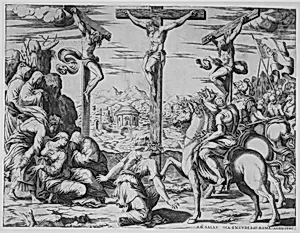
Crucifixion
Medium
Engraving
Classification
Prints
Department
Drawings and Prints
Museum
Metropolitan Museum of Art, New York, NY
Credit
The Elisha Whittelsey Collection, The Elisha Whittelsey Fund, 1949
Accession Number
49.97.191
Rights
Public Domain
Tags
Art Historical Context
This exquisite 16th-century Italian, titled *Crucifixion* and dated 1541, hails from the Metropolitan Museum of Art Drawings and Prints department, of The Elisha Whittelsey Collection.ributed to an anonymous Italian with possible contributions from Girolamoiuoli, Francesco Salati (also known as Francesco de'), and publisher Antonio Salamanca, it exemplifies collaborative world of Renaissance printmaking. Salviati, a prominentist painter active in Rome and Florence, likely provided the design, while Fagiuoli may have executed the engraving, and Salamanca disseminated it—common practice for spreading religious imagery across Europe. The work captures the dramatic biblical scene of Christ's Crucifixion, enriched by the unusual presence of horses, suggesting a lively composition with Roman soldiers or symbolic elements that heighten the tension. Engraving, a meticulous intaglio technique using a burin to incise metal plates, allowed for fine details and multiple impressions, making sacred art accessible to the faithful during the Counter-Reformation era. This period saw a surge in such prints to inspire devotion and counter Protestant critiques. As a cultural artifact, *Crucifixion* reflects Mannerism's elegant distortions and emotional intensity, bridging High Renaissance ideals with emerging Baroque drama. Its survival in the Met's collection underscores the enduring power of prints to democratize art, inviting visitors to ponder faith, suffering, and artistry in one intricate sheet.