
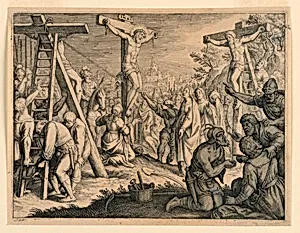
The Crucifixion
Classification
Department
Smithsonian Collection
Museum
Smithsonian American Art Museum
Credit
Smithsonian American Art Museum
Accession Number
1896-31-26
Rights
Public Domain
About this artwork
Research in Progress
Art Historical Context
Michel Lasne’s *The Crucifixion*, created around 1650, offers a compelling glimpse into seventeenth-century French printmaking. As a leading engraver active in Paris during the reign Louis XIII and the early years of Louis XIV, Lasne specialized in religious and devotional subjects that reached wide audiences through affordable printed images. This work, now part of the Smithsonian American Art Museum’s collection, exemplifies how prints served both spiritual and educational purposes in an era when most people encountered sacred art through reproducible media rather than paintings or frescoes. The subject of the Crucifixion carried deep resonance in Counter-Reformation Europe, where the Catholic Church encouraged vivid depictions of Christ’s suffering to inspire faith and devotion. Lasne’s interpretation would have invited viewers to reflect on themes of sacrifice and redemption, themes that remained central to French religious life in the mid-1600s. Though research on this particular impression is still in progress, its presence in an American museum highlights the enduring international interest in French Baroque graphic arts and their role in shaping visual culture across centuries.