
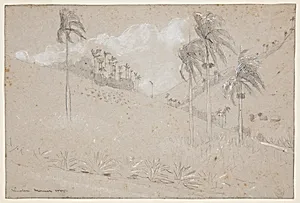
Cuban Hillside
Classification
landscapes
Department
Smithsonian Collection
Museum
Smithsonian American Art Museum
Credit
Gift of Charles Savage Homer, Jr.
Accession Number
1912-12-93
Rights
Public Domain
About this artwork
Research in Progress
Art Historical Context
Winslow Homer, one of America's foremost Realist painters (1836–1910), created *Cuban Hillside* 1885, a evocative landscape that captures the rugged beauty of Cuba's terrain. By this time, Homer had transitioned from his early Civil War illustrations and Maine coastal scenes to broader explorations of nature's power. His mid-1880s travels the Caribbean, including Cuba, offered fresh inspiration, allowing him to depict sun-drenched hillsides alive with tropical drama—a departure from his familiar New England subjects. Homer's landscapes are celebrated for their bold realism, dramatic compositions, and keen observation of light and atmosphere, often painted en plein air to convey nature's immediacy. Though the medium of *Cuban Hillside* remains under study, it exemplifies his skill in rendering expansive vistas that evoke both serenity and elemental force. This work highlights Homer's evolving interest in global locales, bridging American art with exotic influences during a period of artistic expansion post-Civil War. Today, *Cuban Hillside* graces the Smithsonian American Art Museum, a gift from Charles Savage Homer, Jr., offering visitors a window into the artist's wanderlust and enduring legacy in landscape painting. (198 words)