
Cuirass and Tassets (Torso and Hip Defense)
ca. 1510–20
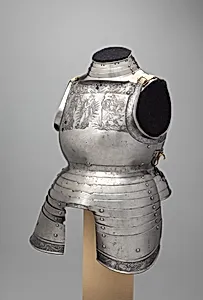
Medium
Steel, leather
Dimensions
H. 41 1/2 in. (105.4 cm); Wt. 19 lb. 8 oz. (8845 g)
Classification
Armor
Culture
German, Augsburg
Department
Arms and Armor
Museum
Metropolitan Museum of Art, New York, NY
Credit
Gift of Marshall Field, 1938
Accession Number
38.143b–d
Rights
Public Domain
Tags
Art Historical Context
Step into the world of chivalry with this stunning *Cuirass Tassets*, a torso and hip defense crafted around1510–20 bysburg masters Kolman Helmsch and Daniel Hopfer.mschmid, from a renowned family of German armorers, shaped the steel plates to perfection, while Hopfer, an innovative etcher, adorned them with intricate religious motifs. Measuring 41½ inches high and weighing a hefty 19½ pounds, this piece exemplifies the peak of Augsburg's armor-making tradition, a hub of craftsmanship during the early 16th century when plate armor reached its zenith before firearms altered warfare forever. Etched scenes depict holy figures like the Madonna and Child, Saint Anne, Saint Christopher, and Saint George—patrons of travelers, warriors, and mothers—blending piety with protection. These decorations, achieved through Hopfer's pioneering etching technique on steel (and accented with leather straps), transformed functional gear into wearable art, reflecting the era's fusion of Gothic devotion and emerging Renaissance humanism. A gift to the Metropolitan Museum of Art from Marshall Field in 1938, this armor invites us to imagine a knight striding into battle, faith etched into every curve. Its cultural weight lies in capturing a vanishing age of armored nobility, where beauty fortified the body and soul.
About the Artist
Kolman Helmschmid|Daniel Hopfer · 1471–1532
**Kolman Helmschmid: Master Armourer of the Renaissance** Kolman Helmschmid (1471–1532), born in Augsburg, Germany, emerged from one of Europe's most illustrious families of armourers, the Helmschmieds, whose name aptly means "helmet smith." The son of the renowned Lorenz Helmschmied (active 1467–1515), Kolman trained within the family workshop, taking control after his father's death in 1515 and...