
Cup and saucer
18th century (?)
Medium
Soft-paste porcelain
Dimensions
Height (Cup): 2 7/16 in. (6.2 cm); Diameter (Saucer): 5 in. (12.7 cm)
Classification
Ceramics-Porcelain
Culture
possibly Belgian, Tournai
Department
European Sculpture and Decorative Arts
Museum
Metropolitan Museum of Art, New York, NY
Credit
Gift of R. Thornton Wilson, in memory of Florence Ellsworth Wilson, 1950
Accession Number
50.211.160, .161
Rights
Public Domain
Tags
Art Historical Context
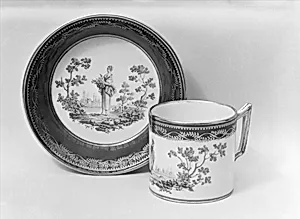
This delicate cup and saucer, crafted in soft-paste porcelain the Tournai factory present-day Belgium, exemplifies 18th-century European ceramics at its finest. Measuring just 2 7/16 inches tall for the cup and inches across the saucer, the set likely features elegant motifs of women amid trees, evoking pastoral scenes popular in Rococo decorative arts. Now housed in the Metropolitan Museum Art's European Sculpture andative Arts department, it a generous gift from R. Thornton Wilson in memory Florence Ellsworth Wilson in 1950. Tournai's porcelain manufactory, active from 1751 to 1799, was renowned for producing soft-paste porcelain—a friable, glass-like material fired at lower temperatures than true hard-paste, allowing intricate molding and painting. This technique enabled the factory to rival Meissen and Sèvres by imitating Chinese export wares while infusing local flair, often with floral, figural, or scenic designs under colorful glazes. The question mark on its 18th-century dating reflects the era's stylistic evolution. As a functional yet luxurious tableware piece, it highlights the cultural craze for porcelain in Enlightenment-era Europe, symbolizing refinement and global trade influences. Visitors will appreciate how such everyday objects bridged art and domestic life, showcasing Tournai's mastery in blending beauty with utility.