
Cup and saucer (gobelet litron et soucoupe)
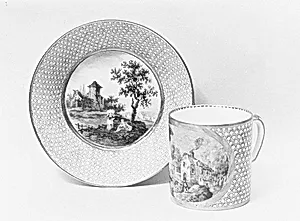
Medium
Soft-paste porcelain
Dimensions
Height (cup [.143]): 2 3/4 in. (7 cm); Diameter (saucer [.144]): 5 5/8 in. (14.3 cm)
Classification
Ceramics-Porcelain
Culture
French, Sèvres
Department
European Sculpture and Decorative Arts
Museum
Metropolitan Museum of Art, New York, NY
Credit
Gift of R. Thornton Wilson, in memory of Florence Ellsworth Wilson, 1950
Accession Number
50.211.143, .144
Rights
Public Domain
Tags
Art Historical Context
This exquisite *Cup and Saucer (Gobelet Litron et Soucoupe)*, crafted around 1772 by the renowned Sèvres Porcelain Manufactory with contributions from painters Jean Bouchet and Mut, exemplifies the height of 18th-century French luxury. Made from soft-paste porcelain—a, translucent material that Europeans perfected before China's hard-paste formula was replicated—its modest dimensions (cup height: 2¾ in.; saucer diameter: 5⅝ in.) belie its opulent craftsmanship. Sèvres, the royal factory patronized by Louis XV, produced these pieces for elite tables, blending technical innovation with artistic finesse. The surfaces are adorned with finely painted scenes featuring human figures amid trees and buildings, likely evoking pastoral idylls or architectural fantasies popular in the era's decorative arts. These enamel decorations, applied over multiple firings, highlight Sèvres' mastery of vibrant colors and intricate detailing, transitioning from Rococo exuberance toward Neoclassical restraint. Such wares were status symbols in fashionable salons, where coffee and chocolate rituals underscored Enlightenment-era refinement. A generous gift to the Metropolitan Museum of Art in 1950, this set invites us to savor the porcelain's glassy sheen and imagine the clink of aristocratic gatherings—timeless elegance from France's golden age of ceramics.
About the Artist
Sèvres Manufactory|Jean Bouchet|Mutel · 1740–present
The Sèvres Manufactory, one of Europe's premier porcelain producers, was established in 1740 as the Manufacture de Vincennes under the patronage of Queen Marie Leszczyńska, who sought to rival Meissen and Chantilly porcelains with French soft-paste innovations. Initially a private venture, it relocated to Sèvres in 1756 in a purpose-built facility designed by architect Laurent Lindet near Madame d...