
Cup and Saucer
c. 1815
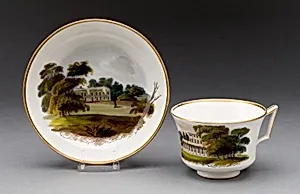
Medium
Porcelain with polychrome enamels and gilding
Dimensions
Cup: 6 × 10.6 cm (2 3/8 × 4 3/16 in.) diam. 9.1 cm (3 9/16 in.) Saucer: H. 2.9 cm (1 1/8 in.) diam. 14 cm (5 1/2 in.)
Classification
drinking vessel
Department
Applied Arts of Europe
Museum
Art Institute of Chicago
Accession Number
15026
Rights
Public Domain
Art Historical Context
This elegant cup and saucer, crafted around 1815 by the renowned Wedgwood Manufactory, exemplifies the refined tableware of early nineteenth-century Europe. Produced in porcelain and adorned with vibrant polychrome enamels and delicate gilding, the set was designed as a drinking vessel for tea or other beverages. Its modest yet precise dimensions—roughly the size of a modern teacup—speak to its role in intimate domestic rituals, where such objects elevated everyday moments into occasions of grace and sophistication. Wedgwood’s mastery of porcelain techniques allowed for luminous surfaces that caught light beautifully, while the layered enamels and gold accents added depth and luxury without overwhelming the form. As part of the Applied Arts of Europe collection at the Art Institute of Chicago, this piece reflects the broader cultural importance of ceramic innovation during the Regency era, when British manufactories supplied refined goods across Europe and beyond. Visitors can appreciate how such vessels combined functionality with artistic expression, turning a simple act of drinking into a display of taste and craftsmanship.
About the Artist
Wedgwood Manufactory
Wedgwood Manufactory, founded on 1 May 1759 by Josiah Wedgwood in Burslem, Staffordshire, England, revolutionized ceramics during the Industrial Revolution. Born into a family of potters, Josiah apprenticed under his elder brother Thomas at the Churchyard Works from age 14, mastering traditional techniques before partnering with Thomas Whieldon from 1754 to 1759, where he honed innovative glazes. ...