
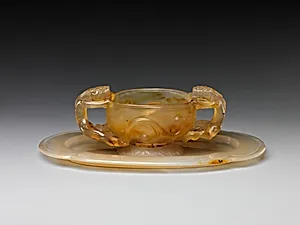
清 瑪瑙雙螭杯|Cup with dragon handles and saucer
Unknown Artist
18th century
Medium
Chalcedony
Dimensions
Cup: H. 1 3/8 in. (3.5 cm); W. 4 in. (10.2 cm) Tray: H. 6 3/8 in. (16.2 cm); W. 4 1/2 in. (11.4 cm)
Classification
Hardstone
Culture & Period
China · Qing dynasty (1644–1911)
Department
Asian Art
Museum
Metropolitan Museum of Art, New York, NY
Credit
Gift of Heber R. Bishop, 1902
Accession Number
02.18.892a, b
Rights
Public Domain
Art Historical Context
This exquisite chalcedony cup with dragon handles and saucer crafted in 18th-century Qing dynasty China, exemplifies the era's mastery of hardstone. Carved from a single block chalcedony—a translucent variety of quartz prized for its subtle banding and luminous quality—the petite cup (just 1⅜ inches tall) features sinuous chilong dragon handles, mythical wingless creatures symbolizing imperial power and auspiciousness. The accompanying saucer or tray, slightly larger at 6⅜ inches high, completes the set, likely designed for serving precious teas or wines in elite settings. Qing artisans, working during the height of the dynasty (1644–1911), elevated hardstone work to an art form, rivaling jade in imperial workshops. Techniques involved meticulous grinding and polishing to reveal the stone's natural veining, creating a jewel-like glow that catches the light. Such objects were status symbols for scholar-officials and the court, blending functionality with symbolic grandeur—dragons evoking the emperor's divine mandate. Today, this treasure resides in the Metropolitan Museum of Art's Asian Art Department, a gift from Heber R. Bishop in 1902. It invites visitors to marvel at Qing China's opulent craftsmanship, where even a humble cup became a vessel of elegance and cultural prestige.