
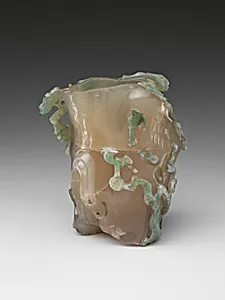
清 玉髓俏色梅竹花插|Vase with bamboo and plum tree
Unknown Artist
18th century
Medium
Chalcedony
Dimensions
H. 5 3/4 in. (14.6 cm)
Classification
Hardstone
Culture & Period
China · Qing dynasty (1644–1911)
Department
Asian Art
Museum
Metropolitan Museum of Art, New York, NY
Credit
Gift of Heber R. Bishop, 1902
Accession Number
02.18.904
Rights
Public Domain
Tags
Art Historical Context
This exquisite chalcedony vase, titled *Vase with Bamboo and Plum Tree* (清 玉髓俏色梅竹花插), hails from 18th-century Qing dynasty China (1644–1911). Standing just 5 3/4 inches (14.6 cm) tall, it exemplifies the era's mastery of hardstone carving, a luxury craft prized by imperial courts. Carved from chalcedony—a microcrystalline quartz prized for its translucency and subtle color variations—the vase functions as a flower insert, blending utility with artistry. The artwork's brilliance lies in the *qiao se* (俏色) technique, where the stone's natural hues are ingeniously exploited to depict bamboo stalks in green-tinged veins and plum blossoms in rosy flecks, creating a vivid, illusionistic scene without added pigments. Plum and bamboo, symbols of resilience and purity in Chinese culture—enduring winter's harshness together—evoke Confucian ideals of steadfast integrity. A gift to the Metropolitan Museum of Art from Heber R. Bishop in 1902, this piece highlights Qing artisans' technical virtuosity and the cultural reverence for nature's motifs in decorative arts. Gaze closely to appreciate how stone mimics life!