
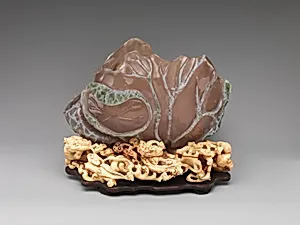
Cup with Lotus Leaves
Unknown Artist
18th century
Medium
Chalcedony
Dimensions
H. 3 1/8 in. (7.9 cm)
Classification
Hardstone
Culture & Period
China · Qing dynasty (1644–1911)
Department
Asian Art
Museum
Metropolitan Museum of Art, New York, NY
Credit
Gift of Heber R. Bishop, 1902
Accession Number
02.18.903
Rights
Public Domain
Tags
Art Historical Context
This delicate **Cup with Lotus Leaves**, crafted in the 18th century China's Qing dynasty (16441911), exemplifies the era's mastery of hardstone. Fashioned from chalcedony—a translucent variety of quartz prized for its clarity and durability—the cup measures just 3 1/8 inches (7.9 cm) high, perfect for a scholar's hand. Its form mimics overlapping lotus leaves, a motif evoking natural elegance and the plant's layered beauty. In Qing imperial workshops, artisans transformed raw chalcedony through meticulous techniques like incising, polishing, and hollowing, revealing the stone's subtle veining to mimic leaf textures and veins. Lotus leaves held profound cultural symbolism in China, representing purity rising from mud and spiritual enlightenment in Buddhist and Confucian traditions. Such cups were luxury objects for elites, used for tea or wine, blending utility with poetic refinement. A gift to the Metropolitan Museum of Art from Heber R. Bishop in 1902, this piece highlights the Qing fascination with nature-inspired hardstones, bridging artistry and philosophy in Asian decorative arts.