
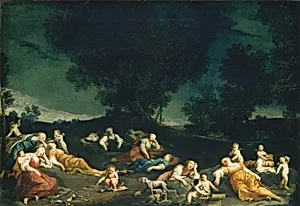
Cupids Disarming Sleeping Nymphs
c. 1690/1705
Medium
oil on copper
Dimensions
overall: 52.4 x 75.5 cm (20 5/8 x 29 3/4 in.) framed: 71.1 x 93.7 x 7.6 cm (28 x 36 7/8 x 3 in.)
Classification
Painting
Department
CIS-B
Museum
National Gallery of Art, Washington, D.C.
Credit
Samuel H. Kress Collection
Accession Number
1939.1.62
Rights
Public Domain
Art Historical Context
Giuseppe Maria Crespi’s *Cupids Disarming Sleeping Nymphs* (c. 1690/1705) captures a playful moment from classical mythology in which mischievous putti gently remove the weapons and attributes of slumbering nymphs. Painted in oil on copper, the work exemplifies the intimate cabinet pictures popular in late Baroque Bologna. The smooth, reflective surface of copper allowed Crespi to achieve luminous color and fine detail, lending the scene a jewel-like delicacy that invites close viewing. Crespi, trained in the Bolognese tradition yet responsive to Caravaggio’s dramatic naturalism, often infused mythological subjects with everyday warmth and gentle humor. Here the nymphs appear relaxed and vulnerable rather than idealized, while the cupids display childlike curiosity—an approach that softens the grandeur of earlier Baroque mythologies and anticipates the lighter spirit of the coming Rococo. Acquired through the Samuel H. Kress Collection, this painting now resides in the National Gallery of Art, where its modest scale (roughly 20 by 30 inches) encourages visitors to appreciate Crespi’s sensitive handling of light and texture. The work reminds us how Baroque artists used familiar stories to explore themes of vulnerability, play, and fleeting repose.
About the Artist
Giuseppe Maria Crespi · 1665–1747
Giuseppe Maria Crespi (1665–1747) was an Italian painter of the late Baroque period whose innovative genre scenes and unorthodox approach to religious painting made him one of the most original artists of early eighteenth-century Bologna. Born in Bologna, he trained under Domenico Maria Canuti, Carlo Cignani, and in the tradition of the Carracci academy, but developed a markedly personal style tha...