
Cupid's Hunting Fields
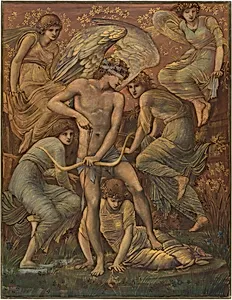
Medium
Gouache, with watercolor and gold and silver paints on ivory wove paper, laid down on linen canvas
Dimensions
99.5 × 76.9 cm (39 3/16 × 30 5/16 in.)
Classification
gouache
Department
Prints and Drawings
Museum
Art Institute of Chicago
Accession Number
12977
Rights
Public Domain
Art Historical Context
Sir Edward Burne-Jones’s *Cupid’s Hunting Fields* (1885) captures the Pre-Raphaelite fascination with myth and romantic allegory. A leading figure in the movement, Burne-Jones often turned to classical and medieval sources to explore timeless themes of love, beauty, and desire. Here, the god of love appears amid lush, imagined fields, suggesting both playfulness and the inexorable pursuit of the heart. The work’s luminous surface—achieved through gouache, watercolor, and touches of gold and silver paint on paper mounted to canvas—gives the scene a jewel-like intensity. This mixed technique, more commonly associated with manuscript illumination than large-scale easel pictures, allowed Burne-Jones to create delicate yet richly textured effects that shimmer under light. The substantial size (nearly 40 by 30 inches) further blurs the line between drawing and painting, underscoring the artist’s lifelong interest in decorative and narrative art. Acquired by the Art Institute of Chicago, the piece reflects Victorian England’s renewed interest in classical mythology as a vehicle for emotional and moral reflection. Its intricate handling of color and metallic highlights rewards close viewing, inviting visitors to linger over the symbolic details of Cupid’s domain.
About the Artist
Sir Edward Burne-Jones · 1833–1898
Edward Coley Burne-Jones was born on 28 August 1833 in Birmingham, the son of a frame-maker, and lost his mother within a week of his birth. He attended King Edward VI Grammar School and the Birmingham School of Art before proceeding to Exeter College, Oxford, in 1852, intending to study theology. At Oxford he formed a lifelong friendship with William Morris, and the two young men became intoxicat...