
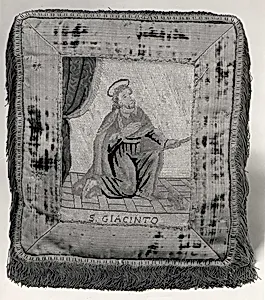
Cushion with Saint Hyacinth
Unknown Artist
19th century
Medium
Silk; metal; cotton
Dimensions
14 1/4 x 12 in. with 2 1/4 in. gusset (36.2 x 30.5 x 5.7 cm)
Classification
Textiles-Ecclesiastical
Culture
Italian
Department
Robert Lehman Collection
Museum
Metropolitan Museum of Art, New York, NY
Credit
Robert Lehman Collection, 1975
Accession Number
1975.1.1850
Rights
Public Domain
Tags
Art Historical Context
This exquisite 19th-century Italian cushion, featuring Saint Hyacinth, invites visitors to explore the artistry of sacred textiles. Crafted from silk, metal threads, and cotton, measures a compact 14¼ x 12 inches with 2¼-inch gusset, its practical use in liturgical settings—perhaps to support heavy missals, relics, or communion vessels during Masses. The unknown artist's skilled embroidery brings the revered saint to life, his figure rendered with intricate metallic highlights that catch the light, evoking divine radiance. Saint Hyacinth, a 13th-century Dominican preacher and miracle worker venerated across Catholic Europe, embodies piety and missionary zeal. In 19th-century Italy, such cushions were essential church furnishings, blending opulent materials with devotional imagery to inspire the faithful. The metallic threads, likely gold or silver-wrapped, not only enhanced durability but also symbolized heavenly splendor, a technique rooted in Renaissance embroidery traditions. Housed in the Metropolitan Museum of Art's Robert Lehman Collection since 1975, this cushion highlights the understated elegance of ecclesiastical textiles. It reminds us how everyday sacred objects carried profound spiritual weight, bridging artistry and worship in Italy's vibrant Catholic heritage.