
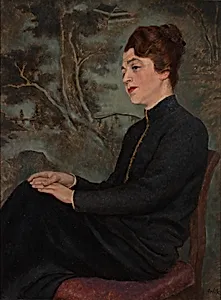
Damenporträt
undatiert
Medium
Öl auf Holz
Dimensions
69,5 x 52 cm
Classification
Tafelbild
Department
Belvedere Collection
Museum
Belvedere
Credit
Belvedere, Vienna
Accession Number
10674
Rights
Public Domain
Art Historical Context
**Damenporträt by Emil Orlik** Nestled in the prestigious Belvedere Collection in Vienna *Damenporträt* (Portrait of a Lady) showcases the refined portraiture skills of Emil Orlik, prominent Austrian artist of the late 19th and early 20th centuries.ed in oil on wood—a traditional panel medium that offers a smooth, durable surface ideal for capturing intricate details and luminous skin tones—this undated work measures 69.5 x 52 cm. As a *Tafelbild* ( painting), it evokes the intimacy of historical portrait traditions while reflecting Orlik's modern sensibilities. Orlik, known for his versatility across painting, printmaking, and graphic design, was a key figure in Vienna's vibrant art scene, influenced by the Secession movement and Japonisme after his travels to Japan. His portraits often blend psychological depth with decorative elegance, highlighting the sitter's poise and personality through subtle brushwork and rich color harmonies. The choice of wood panel underscores a nod to Old Master techniques, lending the piece a timeless quality amid Orlik's innovative style. Housed among masterpieces of Austrian modernism at the Belvedere, this evocative portrait invites visitors to ponder the elegance of an unnamed woman, embodying the cultural sophistication of fin-de-siècle Vienna. A gem for admirers of portraiture, it reveals Orlik's mastery in evoking quiet dignity.
About the Artist
Emil Orlik · 1870–1932
Emil Orlík (1870–1932) was a Czech painter, etcher, and lithographer whose cosmopolitan career bridged the artistic centers of Prague, Vienna, Munich, Berlin, and Tokyo. Born on July 21, 1870, in Prague, Orlík became one of the most important promoters of Japanese art and woodcut techniques in early twentieth-century Europe, directly studying traditional Japanese printmaking methods during two ext...