
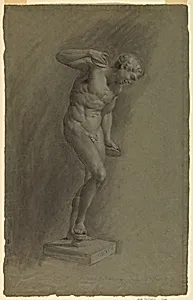
Dancing Faun
Medium
Drawing
Classification
Drawing
Department
Smithsonian Collection
Museum
Smithsonian American Art Museum
Credit
Smithsonian American Art Museum
Accession Number
1905-24-1
Rights
Public Domain
About this artwork
Research in Progress
Art Historical Context
John Trumbull's *Dancing Faun* (1784) is a delicate drawing that captures the artist's early fascination with classical antiquity. Born in 1756, Trumbull was a pivotal figure in American art, transitioning from Revolutionary War service to becoming a renowned neoclassical painter. By 1784, he had traveled to London to study under Benjamin West, immersing himself in European traditions. This work, housed in the Smithsonian American Art Museum, reflects his rigorous training through precise line work typical of preparatory sketches. The subject—a lively faun, the mythological half-human, half-goat companion of the Roman god Bacchus—evokes the joy and abandon of ancient revelry. Rendered in drawing medium, it highlights Trumbull's skill in capturing movement and form, likely inspired by antique sculptures he encountered during his European sojourn. Such studies were essential for neoclassical artists, bridging Greco-Roman ideals with emerging American identity. Though research on this piece is ongoing, *Dancing Faun* offers a window into Trumbull's formative years, blending classical vitality with the disciplined technique that later defined his grand history paintings, like those of the American Founding Fathers. A charming testament to art's timeless dance across cultures.