
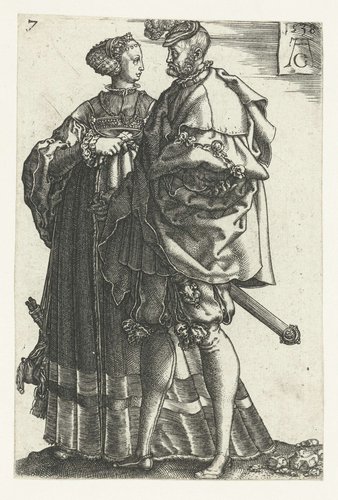
Dansend paar no. 7
Medium
engraving
Dimensions
116; 78
Rights
Public Domain
About this artwork
nummer, verso midden onder, handgeschreven: ‘95’
Art Historical Context
**Dansend paar no. 7** is a delicate engraving by Heinrich Aldegrever, a figure among the German "Little Masters" of the Northern Renaissance, created in 1538 Measuring just 116 mm high by 78 mm wide, this work captures a dancing couple in mid-movement, part of a series that showcases Aldegrever's of small-scale printmaking. Born around 1502 in Paderborn, Aldegrever worked primarily in Soest, blending intricate line work with themes from daily life and mythology, reflecting the era's growing fascination with secular subjects amid the Protestant Reformation. As an engraving, the piece highlights the revolutionary technique of the time: Aldegrever incised fine lines into a copper plate, inking it to produce multiple impressions with remarkable detail. This allowed affordable dissemination of art beyond elite patrons, influencing fashion, dance, and social customs in 16th-century Europe. The fluid poses evoke the lively peasant dances popular in Renaissance Germany, offering a glimpse into festive cultural traditions. A handwritten inscription '95' on the verso, centered at the bottom, adds a layer of mystery—likely a collector's or inventory mark from centuries past. This tiny treasure exemplifies how engravings preserved fleeting moments, making high art accessible to all.
About the Artist
Heinrich Aldegrever · 1502–1561
Heinrich Aldegrever, born in 1502 in Paderborn, Westphalia, to parents Herman and Katherine Trippenmeker—a family of clog-makers known by the dialect name Trippenmecker—emerged as a multifaceted artist in the German Renaissance. His early training remains undocumented, though he likely apprenticed in a Soest goldsmith's workshop after relocating there around 1525, where he joined the painters' gui...