
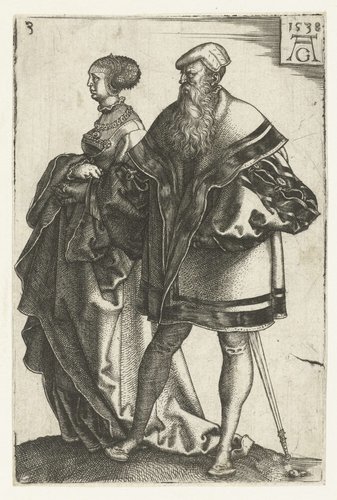
Dansend paar no. 3
Medium
engraving
Dimensions
117; 77
Rights
Public Domain
About this artwork
gravure
Art Historical Context
**Dansend Paar No. 3** is a delicate engraving by Heinrich Aldegrever, a German artist of the Northern Renaissance, created in 1538. just 117 mm high by 77 mm wide, this intimate print exemplifies the "Little Masters"—engravers renowned for their mastery of miniature formats. Aldegrever, active in Soest, was influenced by Albrecht Dürer and specialized in intricate metalwork and prints that captured everyday life, ornaments, and moral themes. The title, translating to "Dancing Couple No. 3," suggests a lively genre scene of paired figures in motion, a popular motif in 16th-century Northern art reflecting social customs and festivities. Aldegrever's engraving technique—incising fine lines into a copper plate with a burin—allowed for exceptional detail and tonal depth in such a compact space. This method made prints affordable and reproducible, spreading artistic ideas across Europe. Culturally, the work highlights the Renaissance fascination with dance as both entertainment and allegory for harmony or courtship. As part of Aldegrever's series, it showcases his versatility, blending realism with decorative flair, and remains a testament to the era's printmaking revolution that democratized art for collectors and scholars alike.
About the Artist
Heinrich Aldegrever · 1502–1561
Heinrich Aldegrever, born in 1502 in Paderborn, Westphalia, to parents Herman and Katherine Trippenmeker—a family of clog-makers known by the dialect name Trippenmecker—emerged as a multifaceted artist in the German Renaissance. His early training remains undocumented, though he likely apprenticed in a Soest goldsmith's workshop after relocating there around 1525, where he joined the painters' gui...