
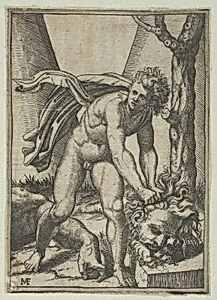
David with the head of Goliath
Medium
Etching with engraving
Dimensions
4 5/8 x 3 3/8 in. (11.8 x 8.6 cm)
Classification
Prints
Department
Drawings and Prints
Museum
Metropolitan Museum of Art, New York, NY
Credit
Harris Brisbane Dick Fund, 1930
Accession Number
30.54.78
Rights
Public Domain
Tags
Art Historical Context
In the Metropolitan Museum of Art's Drawings and Prints department, *David with the Head of* (ca. 1515–16) stands as a masterful collaboration between Raphael, the High Renaissance genius from Urbino, and engraver Marcantonio Raim. This intimate etching with engraving, measuring just 4 5/8 x 3 3/8 inches, captures the biblical hero David triumphantly holding Goliath's severed head—a potent symbol of underdog victory and divine favor from the Old Testament. Raphael's design exemplifies the Renaissance ideal of harmonious anatomy and expressive nobility, while Raimondi's precise technique translates it into a reproducible print. Raimondi's innovative use of etching for fluid lines combined with engraving's sharp detail made such works revolutionary, democratizing access to Raphael's artistry for collectors across Europe. Produced during Raphael's peak in Rome under papal patronage, it reflects the era's fascination with classical heroism and Christian virtue, evoking Michelangelo's nearby David statue. This tiny yet powerful image, acquired via the Harris Brisbane Dick Fund in 1930, highlights printmaking's rise as a bridge between elite painting and public appreciation. Visitors will appreciate its brooding intensity: David's youthful gaze meets the viewer's, Goliath's grim visage a stark contrast, inviting reflection on courage amid turmoil. A gem of technical and narrative brilliance!
About the Artist
Marcantonio Raimondi|Raphael (Raffaello Sanzio or Santi) · 1475–1534
Marcantonio Raimondi (c. 1480–1534), born near Bologna, Italy, emerged as one of the Renaissance's premier engravers, revolutionizing printmaking through his mastery of reproductive techniques. He trained in the workshop of the goldsmith, painter, and niellist Francesco Francia, whose influence is evident in his early engravings, such as the goldsmith-like shading in *Pyramus and Thisbe* (1505), h...