
De Passie
1455 - 1503
Medium
engraving
Dimensions
209; 145
Rights
Public Domain
About this artwork
blad: hoogte 209 mm x breedte 145 mm
Art Historical Context
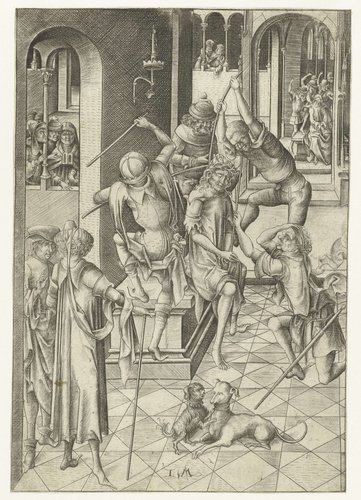
Israhel van Meckenem *De Passie* (The Passion), created between 1455 and 1503, captures a pivotal moment in Christian devotion during the Northern Renaissance. As a German engraver from Meckenheim near Cologne, van Meckenem was a of the medium, producing intricate prints that brought religious narratives to a broader audience. This work likely depicts scenes from Christ's Passion—the suffering, crucifixion, and resurrection—reflecting the era's intense piety amid the late Gothic period's emotional intensity. Engraving, van Meckenem's specialty, involved incising fine lines into a copper plate with a burin, then inking and printing multiples. At 209 mm high by 145 mm wide, *De Passie* exemplifies the technique's precision, allowing for detailed figures, expressive faces, and ornate borders that rivaled painted altarpieces. Unlike unique paintings, engravings democratized art, enabling pilgrims and laypeople to own sacred imagery for private worship. Van Meckenem's style blends Gothic linearity with emerging Renaissance naturalism, often copying innovative contemporaries like the Master E.S. This print's cultural weight lies in its role during religious reforms, fostering personal faith just before the Protestant Reformation. A testament to early printmaking's power, it invites viewers to ponder devotion's visual language.
About the Artist
Israhel van Meckenem · 1435–1503
Israhel van Meckenem (c. 1445–1503), also known as Israhel van Meckenem the Younger, was a pioneering German engraver and goldsmith based in Bocholt, near the Dutch border, renowned as the most prolific printmaker of the fifteenth century. Born into a family possibly of Dutch origin, he was the son of Israhel van Meckenem the Elder, a goldsmith who settled in Bocholt in 1457. He trained initially ...