
Dearest I Love Thee (valentine)
1840/50
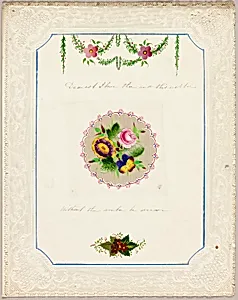
Medium
Collaged elements and watercolor, with pen and brown ink on cut and embossed ivory wove paper (lace)
Dimensions
Folded sheet: 25.1 × 20 cm (9 15/16 × 7 7/8 in.)
Classification
valentine
Department
Prints and Drawings
Museum
Art Institute of Chicago
Accession Number
75500
Rights
Public Domain
Art Historical Context
**Dearest I Love Theevalentine)**, created around 1840–1850, invites us into the heartfelt world of mid-19th-century romance. This delicate folded sheet, measuring 25.1 × 20 cm, hails from the Art Institute of Chicago's and Drawings department. As a classified valentine by an unknown artist, it exemplifies the era's tradition of handmade tokens of affection, exchanged on February 14 to express love and sentimentality before mass-produced cards became common. Crafted with collaged elements, watercolor, and pen and brown ink on cut and embossed ivory wove paper—mimicking fine lace—the artwork showcases remarkable folk artistry. The embossing creates a textured, ornamental border, while collages likely incorporate fabric, feathers, or printed motifs, layered with vibrant watercolors for emotional depth. These techniques highlight the labor-intensive process, often undertaken by women as personal expressions of devotion. Culturally, this valentine reflects Victorian ideals of romantic purity and elaborate courtship rituals in Britain and America. Its intricate design underscores the value placed on handmade gifts, preserving intimate emotions amid industrialization. A charming glimpse into everyday romance, it reminds us how art bridged hearts in a bygone age. (198 words)
About the Artist
Unknown
The artist designated as "Unknown" in our virtual museum's collection exemplifies a poignant chapter in art history: creators whose identities have faded into obscurity despite the enduring power of their work. With only one known artwork attributed to them in our holdings, this figure represents countless anonymous hands that shaped visual culture across centuries. Museums worldwide, including th...