
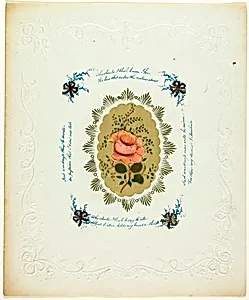
Why Should I Blush (valentine)
c. 1840
Medium
Lithograph and collaged elements, with watercolor and pen and blue ink on cut and embossed ivory wove paper
Dimensions
Folded sheet: 22.9 × 19 cm (9 1/16 × 7 1/2 in.)
Classification
valentine
Department
Prints and Drawings
Museum
Art Institute of Chicago
Accession Number
75674
Rights
Public Domain
Art Historical Context
Created around 1840, George Kershaw’s “Why Should I Blush” is a charming example of the elaborate Victorian valentine. At a time when printed cards were becoming popular, this folded sheet blends commercial production with personal artistry. The title hints at playful romantic sentiment, typical of the era’s customs when such tokens were exchanged to express affection. The work’s medium reveals its inventive spirit. Kershaw combined a lithograph base with collaged elements, watercolor washes, and delicate pen work on embossed ivory paper. This layering of printed imagery and hand-applied color allowed makers to add unique touches while still benefiting from the efficiency of lithography, a relatively new technology in the 1840s. Measuring just over nine inches when folded, the valentine’s intimate scale invites close looking. Today it resides in the Art Institute of Chicago’s collection of prints and drawings, offering visitors a window into both the sentimental rituals and the evolving printmaking techniques of early Victorian England.
About the Artist
George Kershaw
George Kershaw is an artist whose works have been preserved in museum collections in meaningful quantity, pointing to a genuine career and a recognized body of output, even though the biographical details that would identify his nationality, training, and active period have not been established in the sources currently available. The absence of nationality information alongside the absence of date...