
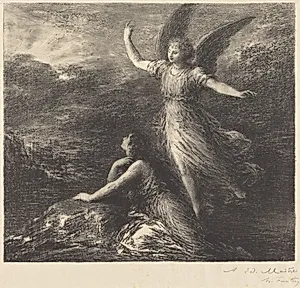
Debut from "Paradise and the Peri" (2nd plate)
Medium
lithograph on Chinese paper
Classification
Department
CG-E
Museum
National Gallery of Art, Washington, D.C.
Credit
Rosenwald Collection
Accession Number
1943.3.3728
Rights
Public Domain
Art Historical Context
Henri Fantin-Latour's *Debut from "Paradise and the Peri" (nd plate)*, created in 1894, is a captivating lithograph on Chinese paper from the artist's evocative series illustrating Thomas Moore's Romantic poem *Lalla Rookh*. This Orientalist tale follows a peri—a mythical winged spirit—seeking redemption by bringing a gift worthy of Paradise's gates. Fantin-Latour, a French Realist painter renowned for his intimate portraits and still lifes, turned to lithography in the 1870s and 1880s to explore literary themes poetic delicacy. The second plate captures the "debut" moment, likely evoking peri's ethereal journey through lush, dreamlike landscapes rendered in soft, velvety tones. Fantin-Latour's mastery of lithography shines here: the medium's crayon-like marks and subtle gradations mimic painting, while the thin, absorbent Chinese paper enhances texture and luminosity, lending an otherworldly glow. This choice reflects fin-de-siècle fascination with Eastern papers among European printmakers, prized for their refinement. Housed in the National Gallery of Art's Rosenwald Collection (Department CG-E), this print exemplifies Fantin-Latour's bridge between Realism and Symbolism, blending precise observation with imaginative storytelling. It invites visitors to ponder 19th-century Romanticism's blend of exoticism and spirituality, a window into an era when poetry and art intertwined to transport the soul.
About the Artist
Henri Fantin-Latour · 1836–1904
Ignace Henri Jean Théodore Fantin-Latour was born on January 14, 1836, in Grenoble, France, to portrait painter Théodore Fantin-Latour, who gave him his earliest drawing lessons. The family relocated to Paris in 1841, where in 1850, at age 14, he enrolled in the École de Dessin, studying under Horace Lecoq de Boisbaudran, whose innovative memory-based method of drawing from observation profoundly ...