
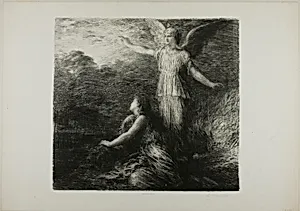
Paradise and the Peri (Opening), first plate
Medium
Lithograph in black on ivory China paper laid down on ivory wove paper
Dimensions
Image: 37.1 × 40.1 cm (14 5/8 × 15 13/16 in.); Sheet: 44.8 × 63.3 cm (17 11/16 × 24 15/16 in.)
Classification
lithograph
Department
Prints and Drawings
Museum
Art Institute of Chicago
Accession Number
44041
Rights
Public Domain
Art Historical Context
Henri Fantin-Latour's *Paradise and the PeriOpening), first plate*1884) invites visitors into a dreamlike realm drawn from Thomas Moore's romantic poem *Lalla Rook*. This lithograph, inaugural image in a celebrated series of 24 plates, captures the mystical moment as a peri—a radiant, fairy-like spirit—approaches the gates of Paradise, symbolizing themes of redemption and divine longing. Fantin-Lour, a French Realist painter renowned for his intimate portraits and still lifes, turned to lithography here to evoke otherworldly atmospheres with exquisite precision. Printed in black ink on delicate ivory China paper laid down on ivory wove paper (image: 37.1 × 40.1 cm), the work showcases lithography's planar technique, allowing for subtle tonal gradations and fluid lines that mimic drawing. Fantin-Latour's mastery shines in the intricate details of ethereal figures and lush paradisiacal motifs, blending Realism's fidelity to form with Romantic fantasy. Produced during the height of 19th-century printmaking's golden age, this piece reflects the era's fascination with Orientalist tales and affordable art reproduction. Housed in the Art Institute of Chicago's Prints and Drawings Department, it exemplifies how lithography democratized high art, bridging elite painting and public appreciation. A gateway to Fantin-Latour's imaginative side, it enchants with its poetic allure.
About the Artist
Henri Fantin-Latour · 1836–1904
Ignace Henri Jean Théodore Fantin-Latour was born on January 14, 1836, in Grenoble, France, to portrait painter Théodore Fantin-Latour, who gave him his earliest drawing lessons. The family relocated to Paris in 1841, where in 1850, at age 14, he enrolled in the École de Dessin, studying under Horace Lecoq de Boisbaudran, whose innovative memory-based method of drawing from observation profoundly ...