
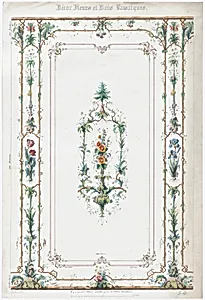
Décor Fleurs et Bois Rustiques.
19th century
Medium
Lithograph with watercolor
Dimensions
Image: 14 1/16 × 9 3/8 in. (35.7 × 23.8 cm) Sheet: 15 1/4 × 10 1/4 in. (38.8 × 26.1 cm)
Classification
Prints
Department
Drawings and Prints
Museum
Metropolitan Museum of Art, New York, NY
Credit
Gift of Harvey Smith, 1976
Accession Number
1976.604.5
Rights
Public Domain
Tags
Art Historical Context
**Décor Fleurs et Rustiques** is a charming 19th French lithograph enhanced with watercolor, created by an anonymous artist possibly linked to Eudes. Measuring about 14 by 9 inches, this delicate print captures an elegant arrangement of flowers intertwined with rustic wooden elements, evoking the natural beauty of the countryside. Housed in the Metropolitan Museum of Art's and Prints department, it was generously gifted by Harvey Smith in 197. Lithography, a revolutionary printing technique perfected in the 19th, allowed for precise reproduction of intricate designs at a fraction of the cost of original paintings. The addition of hand-applied watercolor brings vibrant life to the composition, highlighting the floral motifs—a popular theme in French decorative arts during this era of Romanticism and emerging Art Nouveau influences. Such prints were often used as affordable wall decorations or pattern inspirations for textiles and furniture. This artwork reflects the 19th-century fascination with nature's rustic charm amid France's industrial growth, blending pastoral simplicity with sophisticated craftsmanship. Visitors will appreciate its timeless appeal, a window into how everyday beauty was captured and shared through innovative printmaking.
About the Artist
Anonymous, French, 19th century|Eudes · 1800–1900
**Anonymous, French, 19th Century (ca. 1800–1900)** The artist cataloged as Anonymous, French, 19th century embodies the enigmatic yet essential contributions of unidentified creators to France's vibrant 19th-century art world. Active roughly between 1800 and 1900, this figure—or potentially collective workshop—produced a diverse array of works amid the nation's transition from Neoclassicism thro...