
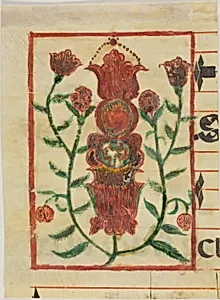
Decorated Initial with Flowers from a Manuscript
n.d.
Medium
Manuscript cutting in tempera and colored inks, with Latin inscriptions in brownish black and red inks, ruled in red, on vellum
Dimensions
22.3 × 16.3 cm (8 13/16 × 6 7/16 in.)
Classification
tempera
Department
Prints and Drawings
Museum
Art Institute of Chicago
Accession Number
151893
Rights
Public Domain
Art Historical Context
This exquisite *Decorated Initial with Flowers a Manuscript* is a delicate fragment cut from a larger medieval or early Renaissance codex, showcasing the artistry of anonymous illuminators. Measuring just 22.3 × 16.3 cm, it features a vibrant large initial letter adorned with blooming flowers in tempera and colored inks on fine vellum—a prepared animal skin prized for its smooth texture and durability. Red ruling lines guide the eye, while Latin inscriptions in brownish-black and red inks hint at its origins in a religious or liturgical text, common in monastic scriptoria. The medium of tempera, a fast-drying paint made from pigments bound with egg yolk, allowed for the luminous colors and fine details that made illuminated manuscripts treasures of their time. Floral motifs like these symbolized beauty, renewal, and divine creation, often enhancing sacred words in Books of Hours or psalters. Such cuttings were prized by collectors in later centuries, preserving these "jewels of the page" as standalone artworks. Housed in the Art Institute of Chicago's Prints and Drawings Department, this piece invites us to marvel at the skill of medieval craftspeople, who turned humble vellum into windows of color and spirituality, bridging art and devotion across centuries.
About the Artist
Unknown
The artist designated as "Unknown" in our virtual museum's collection exemplifies a poignant chapter in art history: creators whose identities have faded into obscurity despite the enduring power of their work. With only one known artwork attributed to them in our holdings, this figure represents countless anonymous hands that shaped visual culture across centuries. Museums worldwide, including th...