
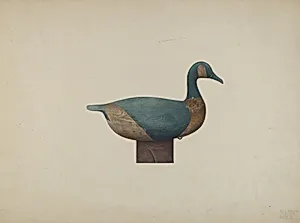
Decoy Duck
c. 1939
Medium
watercolor, graphite, and colored pencil on paperboard
Dimensions
overall: 38 x 56 cm (14 15/16 x 22 1/16 in.)
Classification
Index of American Design
Department
CG-W
Museum
National Gallery of Art, Washington, D.C.
Credit
Index of American Design
Accession Number
1943.8.9732
Rights
Public Domain
Art Historical Context
Behold *Decoy Duck*, a captivating 1939 rendering by Sullivan, part of the Index of American Design at the National Gallery of Art Created during the Great Depression as a Works Progress Administration (WPA) project, the Index employed artists to meticulously document America's folk art and everyday objects, preserving cultural heritage through detailed illustrations. This piece captures a classic wooden duck decoy—a craft essential to waterfowling traditions along the Eastern seaboard. Sullivan masterfully employed watercolor, graphite, and colored pencil on paperboard to evoke the decoy's lifelike plumage, glossy feathers, and subtle contours. Measuring 38 x 56 cm, the work highlights the object's hand-carved simplicity and vibrant paint layers, blending realism with artistic precision typical of Index renderings. These techniques allowed for nuanced shading and color depth, making the humble hunting tool appear almost animated. Culturally, duck decoys embody American ingenuity and regional craftsmanship, from 19th-century Chesapeake Bay carvers to Midwestern makers. Sullivan's depiction underscores their role in sporting life and folk art evolution, inviting visitors to appreciate how everyday objects reflect national identity. A testament to New Deal-era creativity, it reminds us of art's power to safeguard vanishing traditions.