
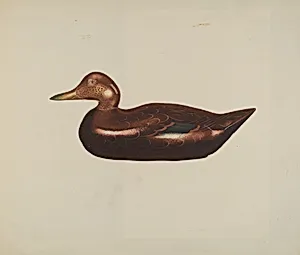
Wooden Duck
1935/1942
Medium
watercolor, graphite, and colored pencil on paper
Dimensions
overall: 36.7 x 42.3 cm (14 7/16 x 16 5/8 in.)
Classification
Index of American Design
Department
CG-W
Museum
National Gallery of Art, Washington, D.C.
Credit
Index of American Design
Accession Number
1943.8.9622
Rights
Public Domain
Art Historical Context
Behold the *Wooden Duck*, a 20th-century American artwork from the National Gallery of Art Index of American Design collection. Created between 1935 and 1942 using watercolor, graphite and colored pencil on papermeasuring 36.7 x 42.3 cm), this meticulously renders a carved wooden duck—likely a folk art decoy used by hunters to lure waterfowl. The mixed media technique brings out the wood's natural grain, vibrant paint layers, and whimsical form with precise graphite outlines and luminous washes, blending documentary accuracy with artistic flair. This work emerged from the Index of American Design, a landmark project of the Works Progress Administration (WPA) during the Great Depression. Hundreds of artists across the U.S. documented everyday objects of national heritage, from quilts to tools, to celebrate American craftsmanship and foster cultural pride amid economic hardship. By preserving these designs in vivid, museum-quality renderings, the Index safeguarded vanishing folk traditions for future generations. The *Wooden Duck* exemplifies early American vernacular art, where utilitarian objects like decoys became sculptural masterpieces through carvers' skill. Its inclusion in the Index highlights the era's recognition of such humble creations as vital to the nation's artistic identity, inviting us to appreciate the ingenuity of everyday makers.
About the Artist
American 20th Century · 1900–1999
"American 20th Century" is the designation used by major institutions such as the National Gallery of Art (NGA) for anonymous and unidentified artists active in the United States during the twentieth century. The artist's personal identity, early life, and training remain undocumented, reflecting the challenges of attribution for unattributed works from this era. No specific teachers, art schools,...