
Decoy
c. 1940
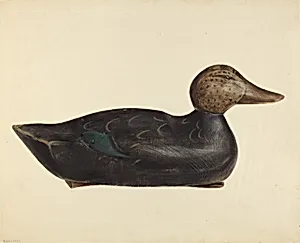
Medium
watercolor, graphite, and pen and ink on paperboard
Dimensions
overall: 29 x 35.8 cm (11 7/16 x 14 1/8 in.) Original IAD Object: 5 1/4" wide; 16" long; 7 1/2" high
Classification
Index of American Design
Department
CG-W
Museum
National Gallery of Art, Washington, D.C.
Credit
Index of American Design
Accession Number
1943.8.16963
Rights
Public Domain
Art Historical Context
"Decoy" by Mina, created around 1940, is a rendering of a carved wooden bird decoy, likely used by hunters to lure waterfowl. Measuring 29 x 35.8 cm, this watercolor, graphite, and pen-and-ink work on paperboard captures the graceful form—originally 5¼ inches wide, 16 inches long, 7½ inches high lifelike detail, from the subtle feathering to the poised stance. Lowry's skilled hand brings to life an everyday artifact of American folk craft, evoking the ingenuity of rural traditions. As part of the Index of American Design (IAD), a Federal Art Project under the Works Progress Administration (WPA) from 1935 to 1942, this piece served a vital cultural mission. During the Great Depression, artists like Lowry documented thousands of American objects—folk art, crafts, and design elements—to celebrate and preserve the nation's heritage. Decoys, hand-carved by craftsmen along coastlines and inland waters, represent a blend of functionality and artistry in early 20th-century sporting culture, highlighting regional self-reliance. Lowry's mixed-media technique—vibrant watercolors for plumage, precise graphite and ink for contours—exemplifies the IAD's emphasis on accurate, colorful documentation. Housed in the National Gallery of Art, "Decoy" invites visitors to appreciate how ordinary tools embodied American creativity and resilience.
About the Artist
Mina Lowry · 1894–1942
Mina Lowry (1894–1942), an American artist born in Canada, emerged as a prominent portrait painter whose career bridged traditional portraiture and the documentation of American folk art. Immigrating to Buffalo, New York, with her family around 1901, she honed her skills early on, winning first prize for modeling at the Albright Art School and studying under the esteemed Florence J. Bach. Lowry fu...