
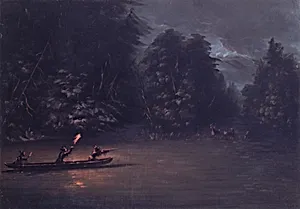
Deer Hunting by Torchlight in Bark Canoes
1846-1848
Medium
Painting
Classification
Painting
Department
Smithsonian Collection
Museum
Smithsonian American Art Museum
Credit
Smithsonian American Art Museum, Gift of Mrs. Joseph Harrison, Jr.
Accession Number
1985.66.554
Rights
Public Domain
Tags
About this artwork
George Catlin looked back nostalgically on his western adventures years after his final journey to the frontier. “In these delightful amusements,” he wrote, “and with these pleasing companions, I have been for a while participating with great satisfaction; I have joined several times in the deer-hunts . . .” (Catlin, Letters and Notes, vol. 2, no. 33, 1841; reprint 1973)
Art Historical Context
George Catlin created "Deer Hunting by Torchlight in Bark Canoes" in the late 1840s, years after his travels among Native American tribes in the American West. Known for his documentary approach to frontier life, Catlin often painted scenes drawn from personal experience, and this work reflects his nostalgic recollection of those adventures. As he wrote, he had “joined several times in the deer-hunts” with companions who made the activity both practical and deeply enjoyable. The painting captures a nighttime hunting scene in which men in bark canoes use torches to illuminate the water and attract deer. This method highlights the intimate knowledge Native hunters held of their environment and the seasonal rhythms of wildlife. Catlin’s choice to revisit the subject later in his career underscores his desire to preserve traditions he feared were disappearing as westward expansion accelerated. As a work in the Smithsonian American Art Museum collection, the painting serves as both an artistic record and a cultural document. Its warm tones and focused composition invite viewers to imagine the quiet tension of the hunt while appreciating Catlin’s role in bringing Western landscapes and lifeways to Eastern audiences in the nineteenth century.
About the Artist
George Catlin · 1796–1872
George Catlin (1796–1872), born in Wilkes-Barre, Pennsylvania, to Putnam Catlin and Polly Sutton—who had been captured by Native Americans during the 1778 Battle of Wyoming—initially pursued a legal career. Trained at Litchfield Law School, he was admitted to the bar in 1819 but abandoned law after two years to study art in Philadelphia in 1823. Self-taught as a portraitist, Catlin quickly gained ...