
Deer in a Landscape
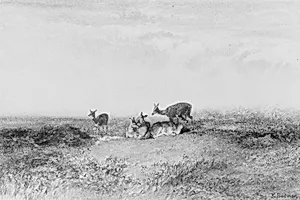
Medium
Watercolor and red chalk on off-white wove paper
Dimensions
7 7/16 x 11 1/4 in. (18.9 x 28.6 cm)
Classification
Watercolor
Culture
American
Department
The American Wing
Museum
Metropolitan Museum of Art, New York, NY
Credit
John Osgood and Elizabeth Amis Cameron Blanchard Memorial Fund, 1993
Accession Number
1993.526
Rights
Public Domain
Tags
Art Historical Context
Karl Bodmer's *Deer in a Landscape* the serene beauty of the American wilderness, likely inspired by his travels along the Missouri River in the early 1830s. A Swiss artist who accompanied Prince Maximilian of Wied-Neuwied on an expedition to document Native American cultures and the untamed West, Bodmer produced meticulous studies that preserved a vanishing frontier. This intimate work, housed in The Metropolitan Museum of Art's American Wing, reflects the Romantic fascination with nature's purity before rapid settlement transformed the continent. Rendered in watercolor and red chalk on off-white wove paper, the piece measures a modest 7 7/16 x 11 1/4 inches, suggesting it was a preparatory sketch or field study. Watercolor's luminous transparency evokes misty atmospheres and dappled light, while red chalk adds warm, textured contours to the deer and foliage, showcasing Bodmer's skill in blending scientific precision with artistic lyricism. Such techniques highlight his role in early American landscape art, bridging European Romanticism and emerging national identity. As an American cultural artifact acquired through the John Osgood and Elizabeth Amis Cameron Blanchard Memorial Fund in 1993, it invites visitors to ponder the harmony between wildlife and habitat—a poignant reminder of the landscapes that shaped a young nation.
About the Artist
Karl Bodmer · 1809–1893
Johann Carl Bodmer was born on February 11, 1809, in Zürich, Switzerland, and received his training as a painter and engraver under his uncle Johann Jakob Meier, who had himself studied under the prominent engraver Heinrich Füssli. By the late 1820s Bodmer had relocated to Koblenz, Germany, where his work came to the attention of Prince Maximilian zu Wied-Neuwied, a German naturalist-explorer plan...