
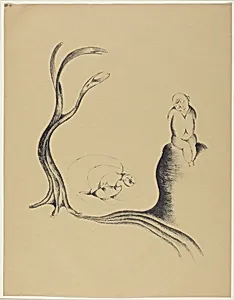
Der Baum der Sehnsucht (The Tree of Longing)
1920
Medium
lithograph on pale brown paper
Dimensions
sheet: 59 × 46 cm (23 1/4 × 18 1/8 in.)
Classification
Portfolio
Department
CG-W
Museum
National Gallery of Art, Washington, D.C.
Credit
Gift of the Collectors Committee
Accession Number
2006.24.11
Rights
Public Domain
Art Historical Context
**Der Baum der Sehnsucht (The Tree of Longing)**, created by Heinrich Hoerle in 1920, is a poignant lithograph on pale brown paper, measuring 59 × 46 cm. Hoerle, a German artist and co-founder of the progressive Cologne-based Gruppe Progress, captured the turbulent spirit of the early Weimar Republic in this work. Produced just two years after World War I's devastation, the piece reflects the era's widespread disillusionment, yearning for renewal, and existential longing—evident in its evocative title, which evokes a symbolic tree as a metaphor for human desire amid societal collapse. Lithography, Hoerle's chosen medium, allowed for intricate tonal variations and subtle textures on the warm, earthy paper, enhancing the print's intimate, dreamlike quality. As part of a portfolio (Department: CG-W), it exemplifies the avant-garde experimentation of the Rhineland artists, blending Expressionist distortion with Dadaist edge. The technique's reproducibility made such bold visions accessible, democratizing art during economic strife. Housed in the National Gallery of Art through the generosity of the Collectors Committee, this work invites visitors to ponder post-war resilience. Hoerle's stark yet poetic imagery reminds us how art channels collective emotion, turning personal longing into universal resonance.
About the Artist
Heinrich Hoerle · 1885–1936
Heinrich Hoerle, born on September 1, 1895, in Cologne, Germany, emerged as a pivotal figure in the radical art scene of the Weimar Republic. He studied at the Cologne School of Arts and Crafts but was largely self-taught, honing his skills amid the turmoil of World War I. In 1919, he married fellow artist Angelika Hoerle (née Fick), with whom he plunged into Cologne's Dada movement, co-founding t...