
Hällucinationen (Hallucinations)
1920
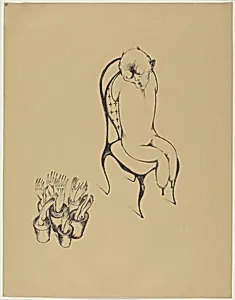
Medium
lithograph on pale brown paper
Dimensions
sheet: 59 × 45.9 cm (23 1/4 × 18 1/16 in.)
Classification
Portfolio
Department
CG-W
Museum
National Gallery of Art, Washington, D.C.
Credit
Gift of the Collectors Committee
Accession Number
2006.24.10
Rights
Public Domain
Art Historical Context
**HällucinationenHallucinations)**, a striking 1920 lithograph by artist Heinrich Hoerle, captures the psychological unrest of the Weimar era. Created on pale brown paper measuring 59 × 45.9 cm, this work belongs to a portfolio classification, suggesting it was part of a designed for broader dissemination. Hoerle, a key figure the Cologne Progressives group drew from the Dada movement's experimental spirit amid post-World War I turmoil in Germany, where societal upheaval and trauma fueled avant-garde expression. The title *Hallucinations* evokes visions of mental distortion, likely reflecting the era's collective disillusionment and the scars of war. Lithography, Hoerle's chosen medium, allowed for precise, reproducible imagery with rich tonal qualities on the tinted paper, enhancing its eerie, dreamlike atmosphere. This technique democratized art, making provocative ideas accessible beyond elite circles. Housed in the National Gallery of Art's CG-W Department through a gift from the Collectors Committee, this piece exemplifies early 20th-century printmaking's role in challenging perceptions. Visitors will appreciate its raw intensity—a window into a fractured world reborn through bold creativity.
About the Artist
Heinrich Hoerle · 1885–1936
Heinrich Hoerle, born on September 1, 1895, in Cologne, Germany, emerged as a pivotal figure in the radical art scene of the Weimar Republic. He studied at the Cologne School of Arts and Crafts but was largely self-taught, honing his skills amid the turmoil of World War I. In 1919, he married fellow artist Angelika Hoerle (née Fick), with whom he plunged into Cologne's Dada movement, co-founding t...