
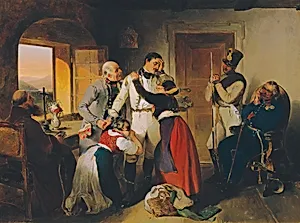
Der letzte Abend eines zum Tode verurteilten Soldaten
1840
Medium
Öl auf Leinwand
Dimensions
60 x 81 cm
Classification
Gemälde
Department
Belvedere Collection
Museum
Belvedere
Credit
Belvedere, Vienna
Accession Number
957
Rights
Public Domain
About this artwork
Der Abschied ist herzzerreißend. Zum letzten Mal gibt der Vater seinem Sohn die Hand, umarmt die Mutter ihr Kind. Die Braut kniet – wie Maria Magdalena am Kreuzesstamm Christi – zu Füßen des zum Tode verurteilten Soldaten. Etwas abseits überwacht ein Offizier die Festnahme. Teilnahmslos zwirbelt er seinen Schnurbart. Wie Pontius Pilatus, der sich nach Christi Verurteilung die Hände wäscht, macht er damit deutlich, dass er für das Todesurteil keine Verantwortung trägt. Das Schicksal des Soldaten ...
Art Historical Context
In Carl Schindler's *Der letzte Abend eines zum T verurteilten Soldaten (1840), an oil on canvas measuring 60 x 81 cm, we witness a heart-wrenching farewell in dimly lit room. A condemned soldier shares his final with his family: his father clasps his hand one last time, his mother embraces him tightly, and his bride kneels at his feet in a pose evoking Mary Magdalene at Christ's cross. This intimate genre scene, housed in Vienna's Belvedere Collection, masterfully captures raw human emotion through Schindler's realistic brushwork and subtle modeling of faces, hallmarks of early 19th-century Austrian painting. Adding dramatic tension, an indifferent officer stands apart, twirling his mustache like Pontius Pilate disclaiming responsibility, underscoring themes of fate and moral detachment. A stark contrast emerges in the soft evening light streaming through the window onto a serene landscape and a tabletop crucifix, while a devout monk observes silently. These biblical allusions elevate the domestic tragedy to a meditation on mortality and faith, resonant in the post-Napoleonic era of military justice and personal sacrifice. This evocative work invites visitors to ponder the fragility of life amid historical upheaval, blending tender pathos with spiritual depth in oil's luminous versatility. A poignant gem of the Belvedere's holdings, it reminds us of art's power to humanize suffering.