
Der Wachposten
um 1840
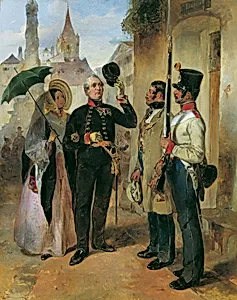
Medium
Öl auf Leinwand
Dimensions
45 x 36,5 cm
Classification
Gemälde
Department
Belvedere Collection
Museum
Belvedere
Credit
Belvedere, Vienna
Accession Number
2102
Rights
Public Domain
About this artwork
Bereits mit 17 Jahren erhielt Carl Schindler vom Verlag L. T. Neumann den Auftrag zu einer umfangreichen Folge von Militärszenen, die als Vorlage für Lithographien dienen sollten. Sowohl diese Arbeit, als auch die vielfältigen, teilweise farbenprächtigen Uniformen, die das Erscheinungsbild Wiens in den zwanziger und dreißiger Jahren des 19. Jahrhunderts prägten, mögen ausschlaggebend gewesen sein, dass er sich intensiv dem Soldatengenre widmete. Militärdarstellungen waren in der österreichischen...
Art Historical Context
"Der Wachposten"The Sentry), painted by Carl Schindler around 0, captures a poignant moment in military life through oil on canvas, measuring 45 x 36.5 cm. This-scale work, now in Vienna's Belvedere Collection, Schindler's mastery of the "Soldatengenre"—genre scenes focusing on soldiers as everyday people. Despite never serving in the military due to frail health, the young artist vividly portrayed sentries, marches, and battles, often set against bourgeois or rural backdrops, humanizing the uniformed figures that defined Vienna's streets in the 1820s and 1830s. At just 17, Schindler received a major commission from publisher L.T. Neumann to create military scenes for lithographic reproductions, sparking his lifelong passion for the theme. Building on Austrian traditions of 18th-century costume sheets—simple military portraits that gained lively backgrounds after 1800—Schindler elevated the genre to new heights. His colorful depictions of vibrant uniforms and narrative depth brought unprecedented emotional resonance to these subjects. Tragically, Schindler died at 21 from tuberculosis, yet his brief career marked a high point for Austrian military painting. "Der Wachposten" invites visitors to reflect on the humanity behind the uniform, blending historical detail with empathetic storytelling in the Biedermeier era's realistic style.