
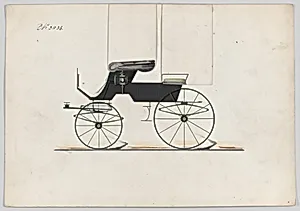
Design for 2 seat Phaeton, no. 3036
1874
Medium
Pen and black ink, watercolor and gouache with gum arabic
Dimensions
sheet: 6 3/4 x 9 5/8 in. (17.1 x 24.5 cm)
Classification
Drawings
Department
Drawings and Prints
Museum
Metropolitan Museum of Art, New York, NY
Credit
Gift of William Brewster, 1923
Accession Number
23.112.659
Rights
Public Domain
Tags
Art Historical Context
Step into the elegant world of 19th-century coachmaking with *Design for 2 Seataeton, no. 3036* by Brewster & Co., created in 1874. This delicate drawing, measuring just 6 3/4 x 9 5/8 inches, captures the blueprint for a sleek, open-air phaeton—a light, four-wheeled carriage by the fashionable elite for leisurely drives. Housed in the Metropolitan Museum of Art Drawings and Prints department, it was generously gifted by William Brewster in 1923. ster & Co., renowned New York carriage makers, epitomized Gilded Age luxury during the horse-drawn era's final flourish, just before automobiles reshaped travel. Phaetons like this two-seater symbolized speed, style, and social status, often customized for discerning clients. This design reflects their mastery in blending form and function, showcasing intricate details from spoked wheels to tufted seats. Rendered in pen and black ink for precise lines, with vibrant watercolor, gouache, and gum arabic for luminous highlights that mimic polished wood and leather, the work highlights the artistry behind industrial design. Gum arabic adds a glossy sheen, evoking the carriages' real-life sheen. A testament to pre-automotive innovation, it invites us to appreciate the craftsmanship that defined an era of refined mobility.
About the Artist
Brewster & Co. · 1837–present
**Brewster & Co.** Brewster & Company, a premier American coachbuilder renowned for its exquisite carriage designs, was established in 1810 in New Haven, Connecticut, by James Brewster (1788–1866). Born in 1788, Brewster trained as a wagonmaker's apprentice starting at age 16 in Northampton, Massachusetts, before relocating to New Haven, where he set up his workshop and quickly gained acclaim for...