
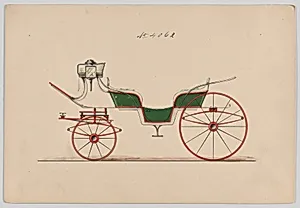
Design for 6 seat Phaeton, no. 4062
1890
Medium
pen and black ink watercolor and gouache with gum arabic
Dimensions
Sheet: 6 5/16 x 9 1/4 in. (16 x 23.5 cm)
Classification
Drawings
Department
Drawings and Prints
Museum
Metropolitan Museum of Art, New York, NY
Credit
Gift of William Brewster, 1923
Accession Number
23.112.976
Rights
Public Domain
Tags
Art Historical Context
This delicate design drawing from 1890 captures a six-seat phaeton, an elegant open carriage favored for leisurely drives and sporting outings in the late nineteenth century. Created by Brewster & Co., America’s premier carriage manufacturer based in New York, the sheet served as both a working blueprint and a presentation piece, showcasing the vehicle’s graceful lines, suspension details, and seating arrangement to prospective clients. Brewster & Co. was renowned for combining traditional European coach-building techniques with American innovation, producing vehicles for prominent families and institutions. Executed in pen and black ink with watercolor and gouache highlights, the small sheet—just over six by nine inches—demonstrates the precision required in the carriage trade. The luminous washes and fine linework allow viewers to appreciate the interplay of light on polished wood, metal fittings, and fabric upholstery, techniques that elevated these designs from mere technical diagrams to works of art. Such drawings formed part of the firm’s extensive archive, preserving the craftsmanship of an era soon to be transformed by the automobile. Acquired by the Metropolitan Museum of Art in 1923 as a gift from William Brewster, this piece offers a vivid glimpse into the refined world of Gilded Age transportation design.
About the Artist
Brewster & Co. · 1837–present
**Brewster & Co.** Brewster & Company, a premier American coachbuilder renowned for its exquisite carriage designs, was established in 1810 in New Haven, Connecticut, by James Brewster (1788–1866). Born in 1788, Brewster trained as a wagonmaker's apprentice starting at age 16 in Northampton, Massachusetts, before relocating to New Haven, where he set up his workshop and quickly gained acclaim for...