
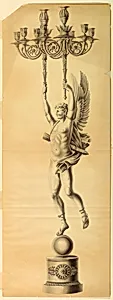
Design for a Candelabrum
Classification
Drawing
Department
Smithsonian Collection
Museum
Smithsonian American Art Museum
Credit
Purchased for the Museum by the Advisory Council
Accession Number
1911-28-356
Rights
Public Domain
About this artwork
Research in Progress
Art Historical Context
Joseph Anton Seethaler II’s “Design for a Candelabrum,” created between 1825 and 1835, offers a glimpse into the refined decorative tastes of early nineteenth-century Germany. As a drawing held in the Smithsonian American Art Museum, the work captures the artist’s careful planning for an ornate lighting fixture, likely intended for a domestic or ceremonial setting. Seethaler, who lived from 1799 to 1868, worked during a period when German artisans blended neoclassical elegance with emerging romantic sensibilities, producing objects that balanced functionality and artistic expression. Though the medium remains unspecified and research on the piece is ongoing, its classification as a drawing highlights the importance of preparatory sketches in the decorative arts. Such designs allowed artists like Seethaler to explore intricate details—scrolling arms, floral motifs, or figural elements—before translating them into metal, porcelain, or wood. Acquired for the museum by the Advisory Council, the drawing preserves a moment of creative process from a lesser-documented German craftsman. Visitors can appreciate how this modest sheet connects everyday household objects to broader artistic traditions, reminding us that even utilitarian items once received the same thoughtful attention as paintings or sculpture.