
Design for a Chimneypiece
1740–1800
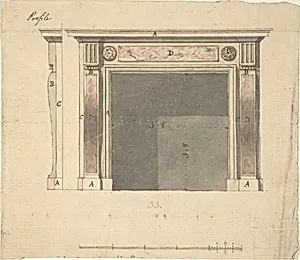
Medium
Pen and ink, brush and wash
Classification
Drawings|Ornament & Architecture
Department
Drawings and Prints
Museum
Metropolitan Museum of Art, New York, NY
Credit
The Elisha Whittelsey Collection, The Elisha Whittesley Fund, 1949
Accession Number
49.56.39
Rights
Public Domain
Art Historical Context
Sir William Chambers, a leading British neoclassical architect of the 18th century created this *Design for a Chimneiece* sometime between 1740 and 1800. Renowned for grand projects like Somerset House and his influential treatise *Treatise on Civil Architecture* (1759), Chambers drew inspiration his travels in France and Italy, blending classical symmetry with elegant ornamentation. Chimneypieces, or ornate fireplace surrounds, were focal points in Georgian interiors, symbolizing wealth and sophistication in aristocratic homes. Rendered in pen and ink with brush and wash, the drawing exemplifies the precision of architectural drafting. Fine pen lines delineate intricate details—scrolls, pediments, and floral motifs—while translucent washes add depth, mimicking stone textures and modeling light and shadow. This technique allowed architects like Chambers to vividly communicate designs to patrons and craftsmen, bridging concept and construction. Housed in the Metropolitan Museum of Art's Drawings and Prints department as part of The Elisha Whittelsey Collection, this work highlights the era's obsession with harmonious proportions and revived antiquity. It offers a glimpse into how neoclassical ideals transformed everyday domestic spaces into statements of refined taste.
About the Artist
Sir William Chambers · 1723–1796
### Sir William Chambers (1723–1796) Born on 23 February 1723 in Gothenburg, Sweden, to parents of Scottish descent—his father a merchant—Sir William Chambers embarked on an extraordinary path that bridged continents and cultures. At just 16, after initial education in England, he joined the Swedish East India Company, undertaking three voyages to China in the 1740s. These journeys profoundly sha...