
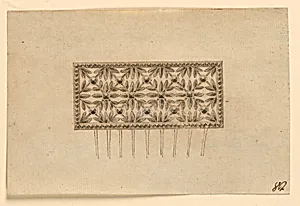
Design for a Comb
early 19th century
Medium
jewelry
Classification
jewelry
Department
Smithsonian Collection
Museum
Smithsonian American Art Museum
Credit
Museum purchase through gift of various donors and from Eleanor G. Hewitt Fund
Accession Number
1938-88-772
Rights
Public Domain
About this artwork
Research in Progress
Art Historical Context
This delicate *Design for a Comb* the early 19th offers a glimpse into the elegant world of American jewelry design during a time of neoclassical revival and growing fashion sophistication. As a preparatory sketch or blueprint, it captures the artistry behind personal adornments that graced the hair of women in Regency and early Victorian society. Combs like this were not mere accessories but symbols of refinement, often crafted from materials such as tortoise shell, gold, or, and embellished with pearls, gemstones, or intricate filigree to complement elaborate hairstyles. Though the artist remains unknown, the design reflects the period's emphasis on symmetry, classical motifs, and fine detailing—hallmarks of skilled jewelers responding to European influences while developing a distinctly American aesthetic. Held in the Smithsonian American Art Museum's jewelry collection, acquired through generous donors and the Eleanor G. Hewitt Fund, it highlights the museum's commitment to preserving ephemeral designs that shaped everyday luxury. Research into this piece is ongoing, inviting us to ponder its untold stories: perhaps it adorned a prominent figure or inspired a series of combs in a artisan's workshop. Such artifacts remind us how jewelry bridged art, culture, and personal expression in early America.
About the Artist
Unknown
The artist designated as "Unknown" in our virtual museum's collection exemplifies a poignant chapter in art history: creators whose identities have faded into obscurity despite the enduring power of their work. With only one known artwork attributed to them in our holdings, this figure represents countless anonymous hands that shaped visual culture across centuries. Museums worldwide, including th...