
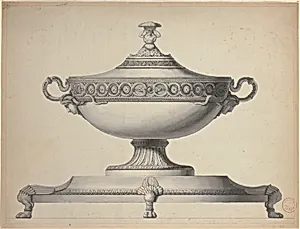
Design for a Covered Tureen on a Footed Stand
ca. 1770–1800
Medium
Pen and black ink, brush and gray wash.
Dimensions
17 13/16 x 23 1/16 in. (45.2 x 58.5 cm)
Classification
Drawings|Ornament & Architecture
Department
Drawings and Prints
Museum
Metropolitan Museum of Art, New York, NY
Credit
Purchase, Rogers Fund and The Elisha Whittelsey Collection, The Elisha Whittelsey Fund, 1978
Accession Number
1978.521.1
Rights
Public Domain
Tags
Art Historical Context
This exquisite design drawing for a *Covered Tureen on aed Stand* by Henri Auguste and Jean Guillaume Mo dates to around 1770–1800, capturing the refined elegance of late 18-century French decorative arts.itte, a prominent engraver and ornamental designer, specialized in creating intricate patterns for luxury objects, bridging the ornate Rococo style with emerging Neoclassicism. Tureens like this—elaborate serving vessels for soups and stews—were prized status symbols in aristocratic and bourgeois dining rooms, often crafted in silver or porcelain to showcase wealth and taste. Rendered in pen and black ink with brush and gray wash on a generous sheet (17 13/16 x 23 1/16 in.), the work demonstrates masterful draftsmanship. The gray wash adds depth and shadow, helping visualize the tureen's sculptural form, ornate lid, and sturdy footed base. Such preparatory drawings were essential for silversmiths and porcelain makers, guiding the translation from two dimensions to opulent three-dimensional masterpieces. Housed in The Metropolitan Museum of Art's Drawings and Prints department, this piece highlights the collaborative artistry behind everyday luxury. It offers a window into the opulent world of ancien régime France, just before the Revolution reshaped tastes toward simplicity. Visitors will appreciate its precision and poise—a testament to Moitte's enduring influence on ornamental design.
About the Artist
Henri Auguste|Jean Guillaume Moitte · 1759–1816
**Henri Auguste (1759–1816)** was a leading Parisian gold- and silversmith renowned for his elegant neoclassical and Empire-style works in *orfèvrerie*. As the only son of the royal goldsmith Robert-Joseph Auguste (1723–1805), he assumed ownership of his father’s workshop in 1784–85 and carried forward the family tradition of refined, classically inspired silverware. Auguste collaborated closely ...