
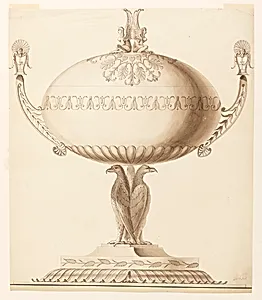
Design for a Tureen
1825-1835
Medium
Drawing
Classification
Drawing
Department
Smithsonian Collection
Museum
Smithsonian American Art Museum
Credit
Purchased for the Museum by the Advisory Council
Accession Number
1911-28-372
Rights
Public Domain
About this artwork
Research in Progress
Art Historical Context
Behold *Design for a Tureen by Johann Nepomuk a delicate drawing from the 1825–1835 now housed in the Smithsonian American Museum. Created as a preparatory sketch, this work outlines an elegant serving vessel—a tureen—used for soups and stews in grand 19th-century dining settings Acquired through purchase by the museum's Advisory Council, it the meticulous planning behind luxury tableware, bridging artistry and craftsmanship. In the early 19th century, such designs were vital blueprints for silversmiths, porcelain makers, or potters, capturing the era's refined aesthetics amid shifting tastes from neoclassicism toward more personal expressions. Nepomuk's drawing highlights the precision of the pencil medium, allowing artists to experiment with proportions, ornate handles, lids, and decorative motifs before committing to costly production. These sketches preserved innovative ideas, influencing household luxury across Europe and America. Though research into this piece continues, it invites us to appreciate the unsung role of designers like Nepomuk in shaping everyday opulence. A testament to the Smithsonian's commitment to decorative arts, it reminds visitors how a simple drawing could grace the world's finest tables.
About the Artist
Johann Nepomuk · 1790–1870
Johann Nepomuk Muxel (1790-1870) was a German painter and etcher who devoted much of his career to documenting the celebrated art collection of Eugene de Beauharnais, Duke of Leuchtenberg, through meticulous reproductive prints. Born on April 20, 1790, in Munich and dying on May 17, 1870, also in Munich, Muxel's eighty-year life spanned a crucial period in European art history when reproductive pr...