
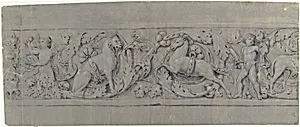
Design for a Decorative Frieze
ca. 1825–50
Medium
Graphite, black chalk, heightened with white
Dimensions
sheet: 6 7/8 x 16 13/16 in. (17.5 x 42.7 cm)
Classification
Drawings
Department
Drawings and Prints
Museum
Metropolitan Museum of Art, New York, NY
Credit
Gift of Regina Slatkin, 1963
Accession Number
63.712.6
Rights
Public Domain
Tags
Art Historical Context
This delicate drawing, titled *Design for a Decorative Frieze*, was created by an French artist between 1825 and 1850. Intended as a preparatory study, it captures the elegant, flowingation typical of 19th-century French decorative arts. The horizontal composition features stylized horses and lions integrated into intricate patterns, suggesting its use for architectural moldings, furniture, or interior paneling during the Romantic era’s revival of classical and exotic motifs. The artist employed graphite and black chalk, heightened with white, on a modest sheet measuring roughly 6 7/8 by 16 13/16 inches. This combination of media allows for precise linework alongside soft shading and luminous highlights, giving the animals a sense of vitality and three-dimensional form. Such techniques were essential for designers communicating their visions to craftsmen or patrons. Housed in the Metropolitan Museum of Art’s Department of Drawings and Prints, the work was gifted by Regina Slatkin in 1963. It offers visitors a glimpse into the collaborative world of 19th-century ornament, where anonymous draftsmen played a vital role in shaping the luxurious interiors of their time.
About the Artist
Anonymous, French, 19th century · 1800–1900
**Anonymous, French, 19th Century (ca. 1800–1900)** The artist cataloged as Anonymous, French, 19th century embodies the enigmatic yet essential contributions of unidentified creators to France's vibrant 19th-century art world. Active roughly between 1800 and 1900, this figure—or potentially collective workshop—produced a diverse array of works amid the nation's transition from Neoclassicism thro...