
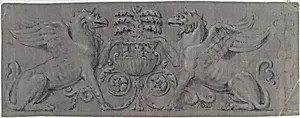
Design for a Decorative Frieze
ca. 1825–50
Medium
Graphite, black chalk, heightened with white. Framing lines in black chalk.
Dimensions
sheet: 5 1/4 x 13 5/8 in. (13.4 x 34.6 cm)
Classification
Drawings
Department
Drawings and Prints
Museum
Metropolitan Museum of Art, New York, NY
Credit
Gift of Regina Slatkin, 1963
Accession Number
63.712.2
Rights
Public Domain
Tags
Art Historical Context
This delicate *Design for a Decorative Frieze*, created by an anonymous French artist around 1825–50, captures the elegance of 19th-century ornamental drafting. Rendered on a modest sheet measuring 5¼ x 13⅝ inches, the work employs graphite and black chalk for precise lines and shading, with white heightening to add luminous depth and framing lines in black chalk for crisp definition. Such mixed-media techniques were hallmarks of preparatory drawings, allowing artists to model forms with subtle tonal contrasts ideal for envisioning architectural embellishments. At its heart are majestic griffins—mythical hybrids of lion and eagle—arranged in a rhythmic frieze pattern, evoking ancient motifs revived during France's eclectic Revival styles. Griffins, symbols of strength and divine protection since antiquity, were popular in neoclassical and Empire interiors, adorning walls, furniture, and public spaces amid the post-Napoleonic era's taste for grandeur. This anonymous sheet likely served as a pattern for artisans, reflecting the collaborative world of decorative workshops where such designs fueled opulent commissions. Housed in the Metropolitan Museum of Art's Drawings and Prints department (gift of Regina Slatkin, 1963), it offers a window into the unsung craft of 19th-century design, blending technical finesse with timeless symbolism for visitors to admire.
About the Artist
Anonymous, French, 19th century · 1800–1900
**Anonymous, French, 19th Century (ca. 1800–1900)** The artist cataloged as Anonymous, French, 19th century embodies the enigmatic yet essential contributions of unidentified creators to France's vibrant 19th-century art world. Active roughly between 1800 and 1900, this figure—or potentially collective workshop—produced a diverse array of works amid the nation's transition from Neoclassicism thro...