
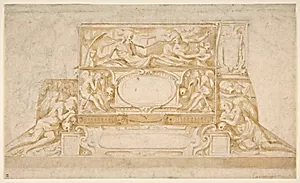
Design for a Funerary Monument
Medium
Brush and brown wash, over black chalk
Dimensions
sheet: 7 x 11 11/16 in. (17.8 x 29.7 cm)
Classification
Drawings
Department
Drawings and Prints
Museum
Metropolitan Museum of Art, New York, NY
Credit
The Elisha Whittelsey Collection, The Elisha Whittelsey Fund, 1961
Accession Number
61.547
Rights
Public Domain
Tags
Art Historical Context
Francesco Salviati, born Francesco de' Rossi (0–1563), was a leading Mannerist artist in 16th-century Italy, renowned for his elegant, elongated figures and intricate compositions influenced by Michelangelo and Raphael. This preparatory drawing, *Design for a Funer Monument*, exemplifies his skill in architectural and figural design. Executed in brush and brown wash over black on a modest sheet measuring 7 x 11 11/16 inches, it captures the fluid, expressive lines typical of Mannerist draftsmen working in Florence and Rome. The design likely envisions an elaborate tomb, featuring skeletal figures—powerful symbols of mortality in Renaissance art—and female forms, possibly mourners or allegorical virtues like Faith or Charity. Such motifs drew from *memento mori* traditions, reminding viewers of life's transience amid the grandeur of ecclesiastical monuments commissioned by nobility and clergy. Salviati's wash technique adds depth and tonal drama, simulating stone or bronze while allowing rapid exploration of complex spatial arrangements. Housed in the Metropolitan Museum of Art's Drawings and Prints department, this work highlights the Renaissance emphasis on disegno (preparatory drawing) as the foundation of grand projects. It offers a glimpse into the creative process behind opulent funerary art, blending piety, anatomy, and artistic virtuosity for eternal commemoration.