
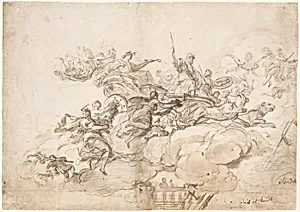
The Triumph of Cybele
ca. 1697
Medium
Brush and brown wash over black chalk
Dimensions
14-3/4 x 20-7/8 in. (37.5 x 53.0 cm)
Classification
Drawings
Department
Drawings and Prints
Museum
Metropolitan Museum of Art, New York, NY
Credit
Rogers Fund, 1963
Accession Number
63.76.4
Rights
Public Domain
Tags
Art Historical Context
In the electrifying world of Baroque art, Luca Giordano's *The Triumph of Cybele* (ca. 1697) captures the mythological grandeur of the ancient Phrygian goddess of nature and fertility. Rendered in brush and brown wash over black chalk, this dynamic drawing depicts Cybele's victorious procession, likely featuring her iconic lion-drawn chariot amid swirling human figures, fierce animals, battling warriors, and ornate shields. Giordano, the prolific Neapolitan master known as "Luca Fa Presto" for his lightning-fast execution, infuses the scene with dramatic movement and theatrical energy, hallmarks of the Baroque style that celebrated exuberance and divine power. This preparatory drawing exemplifies Giordano's virtuoso technique: the fluid black chalk underdrawing provides structure, while translucent brown washes add depth, shadow, and a sense of immediacy, evoking the illusion of a full painting. At 14-3/4 x 20-7/8 inches, its intimate scale belies the epic subject, showcasing how 17th-century artists like Giordano used such works to sketch grand compositions before committing to canvas. Acquired through the Rogers Fund in 1963, this piece from the Metropolitan Museum of Art's Drawings and Prints collection highlights Cybele's enduring cultural resonance—from Roman cults honoring her with ecstatic rites to Baroque revivals symbolizing triumph over chaos. A window into Giordano's late-career brilliance during his Spanish sojourn, it invites visitors to marvel at the goddess's wild, untamed glory.
About the Artist
Luca Giordano · 1634–1705
Luca Giordano (1634–1705) was an Italian painter of the late Baroque period who was one of the most prolific and versatile artists of the seventeenth century, earning the nickname "Luca fa presto" ("Luca works fast") for his extraordinary speed of execution. Born in Naples, he studied under José de Ribera and traveled extensively in Italy, absorbing influences from the Venetian colorists, Pietro d...