
Design for a Neo-Classical Building
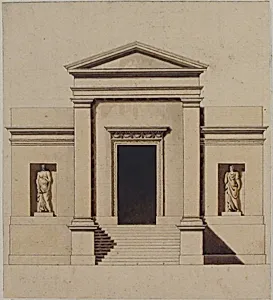
Medium
Pen and brown ink, brush and brown wash
Dimensions
6 1/2 x 5 7/8 in. (16.5 x 14.9 cm)
Classification
Drawings|Ornament & Architecture
Department
Drawings and Prints
Museum
Metropolitan Museum of Art, New York, NY
Credit
The Elisha Whittelsey Collection, The Elisha Whittelsey Fund, 1948
Accession Number
48.148(14)
Rights
Public Domain
Tags
Art Historical Context
This delicate architectural drawing, titled *Design for a Neo-Classical Building*, captures the elegance of 18th-century French design by an anonymous artist. Rendered in pen and brown ink with brush and brown wash on a modest sheet measuring just 6½ x 5⅞ inches, it exemplifies the precision of preparatory sketches used by architects and designers of the era. Housed in the Metropolitan Museum of Art's Drawings and Prints department, this work from The Elisha Whittelsey Collection highlights the meticulous planning behind grand visions. Neo-Classicism, flourishing in France during the late 18th century amid the Enlightenment, revived ancient Greek and Roman forms to symbolize reason, order, and civic virtue. This design likely proposes a facade or structure with symmetrical columns, pediments, and classical motifs—hallmarks of the style championed by architects like Claude-Nicolas Ledoux. Such drawings were essential tools for communicating ideas to patrons, blending technical accuracy with artistic flourish. The brown wash technique adds depth and shadow, simulating how light would play across the stone surfaces, making the two-dimensional sketch vividly three-dimensional. As a snapshot of pre-Revolutionary France's architectural ambitions, it invites us to imagine the monumental buildings that shaped modern cities.
About the Artist
Anonymous, French, 18th century · 1700–1800
The artist known as Anonymous, French, 18th century, represents a collective of unidentified talents active roughly between 1700 and 1800, a period of profound artistic evolution in France from the opulent Rococo to the austere dawn of Neoclassicism and Revolutionary fervor. Little is documented about their personal training or mentors, as their anonymity obscures individual biographies, though th...