
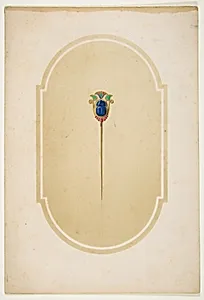
Design for a pin with a blue scarab
19th century
Medium
Ink and watercolor on cardboard
Dimensions
sheet: 8 7/8 x 6 in. (22.6 x 15.3 cm)
Classification
Drawings
Department
Drawings and Prints
Museum
Metropolitan Museum of Art, New York, NY
Credit
The Elisha Whittelsey Collection, The Elisha Whittelsey Fund, 1959
Accession Number
59.564.42
Rights
Public Domain
Tags
Art Historical Context
This delicate ink and watercolor drawing on cardboard, measuring 8 7/8 x 6 inches, presents a refined design for a pin featuring vibrant blue scarab beetle. Created by an anonymous French artist in 19th century, exemplifies the exquisite preparatory sketches used by jewelers and designers of the era to envision wearable adornments. Housed in the Metropolitan Museum of Art's Drawings and Prints department as part of The Elisha Whittelsey Collection (acquired in 1959), the work highlights the precision of ink lines combined with the luminous washes of watercolor, techniques that allowed artists to convey texture, color, and gleam on an intimate scale. In 19th-century France, amid the height of Egyptomania sparked by Napoleon's campaigns and archaeological discoveries like Tutankhamun's tomb precursors, scarabs—ancient Egyptian symbols of rebirth and protection—became wildly popular motifs in jewelry and decorative arts. This pin design reflects that cultural fascination, blending orientalist exoticism with the refined Aesthetic Movement's love for natural forms and gemstone hues. Such preparatory drawings were essential in haute joaillerie workshops, bridging artistic imagination with artisanal craftsmanship. Visitors will appreciate how this unassuming sheet captures a moment of creative fusion between past and present, inviting us to imagine the scarab pin sparkling on a Victorian lapel.
About the Artist
Anonymous, French, 19th century · 1800–1900
**Anonymous, French, 19th Century (ca. 1800–1900)** The artist cataloged as Anonymous, French, 19th century embodies the enigmatic yet essential contributions of unidentified creators to France's vibrant 19th-century art world. Active roughly between 1800 and 1900, this figure—or potentially collective workshop—produced a diverse array of works amid the nation's transition from Neoclassicism thro...