
Village à Dieppe
1843
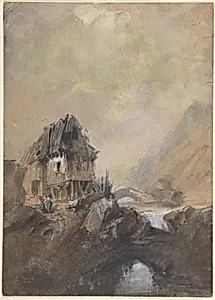
Medium
Watercolor and gouache on cardboard
Dimensions
sheet: 10 3/4 x 7 3/4 in. (27.3 x 19.7 cm)
Classification
Drawings
Department
Drawings and Prints
Museum
Metropolitan Museum of Art, New York, NY
Credit
Karen B. Cohen Fund, 2003
Accession Number
2003.83
Rights
Public Domain
Tags
Art Historical Context
Eugène Isabey'sVillage à Dieppe*1843) captures the charming coastal essence of Dieppe, a Normandy fishing town popular among 19th-century artists. Rendered in watercolor and gouache on, this intimate sheet (10 3/4 x 7 3/4 in.) showcases a cluster of houses nestled in a landscape, evoking the poetry of rural French life. Isabey, a French painter influenced by marine and landscape traditions, often sketched en plein air, infusing his works with atmospheric light and subtle drama. The medium's significance lies in its versatility: watercolor's fluidity conveys misty skies and verdant fields, while gouache's opacity adds depth to the sturdy village structures. Created during the 1840s—a time when artists like Isabey bridged Romanticism and emerging Realism—this piece reflects a growing fascination with unidealized nature and local scenes, prefiguring Impressionist plein-air experiments. Housed in the Metropolitan Museum of Art's Drawings and Prints department (Karen B. Cohen Fund, 2003), *Village à Dieppe* invites viewers to linger on its delicate textures, offering a window into 19th-century France's serene seaside world.
About the Artist
Eugène Isabey · 1803–1886
Eugène Isabey (1803–1886) was a French painter and lithographer known for his dramatic seascapes, coastal scenes, and historical compositions. Born in Paris, he was the son of the celebrated miniaturist and portraitist Jean-Baptiste Isabey, who provided his early artistic training. The younger Isabey studied briefly with various masters but was largely shaped by his father's studio and by his own ...